BlogReviews
Apollo.io Review 2026

By Rahul LakhaneyPublished on: May 25, 2026 · 9 min read · Last reviewed: May 2026
On this page
TL;DR
Apollo.io is one of the most-reviewed sales intelligence platforms on G2 (~9,344 reviews at 4.7/5 at the time of writing, per G2's listing). Here is an honest 2026 review of its data accuracy, pricing, and the gaps that send teams looking for alternatives.
Apollo is the best all-in-one prospecting platform for startups and SMBs that want transparent pricing and a workflow that goes from list to first touch in one tool. It loses points on direct-dial accuracy, occasional data freshness issues, and AI features that are useful but not flawless.
Best for: Startups, SMBs, and self-serve sales teams running email-led outbound.
Not ideal for: Enterprise teams that need the best direct dials and deep intent, or anyone who needs the highest possible match rate from a single tool.
Apollo gives you a 275M+ contact database, multi-step sequences, a built-in dialer, and basic deal tracking, all on public per-seat pricing with a free plan. For the money, it is hard to beat as an all-in-one. The trade-offs are variable phone accuracy, data that can go stale, and the fact that a single database has coverage gaps. Teams that need higher match rates often layer a waterfall enrichment tool like Enrich underneath Apollo.
Apollo.io is a sales intelligence and engagement platform. Apollo's own homepage advertises a 275M+ contact database and states "Millions of sellers at over 600,000 companies beat their number with Apollo" (both figures are self-reported by Apollo). You search the database, filter by firmographics and personas, reveal emails and phone numbers, and push prospects into sequences you run from the same tool. It also includes a dialer, basic CRM and deal features, and an AI layer for writing and prioritization.
The core appeal is consolidation. Instead of buying a data provider, a sequencer, and a dialer separately, a small team can run its entire outbound motion inside Apollo on one bill. According to G2's listing at the time of writing, Apollo carries roughly a 4.7/5 average rating across ~9,344 reviews in the Sales Intelligence category, which is a substantial and broadly positive review base.
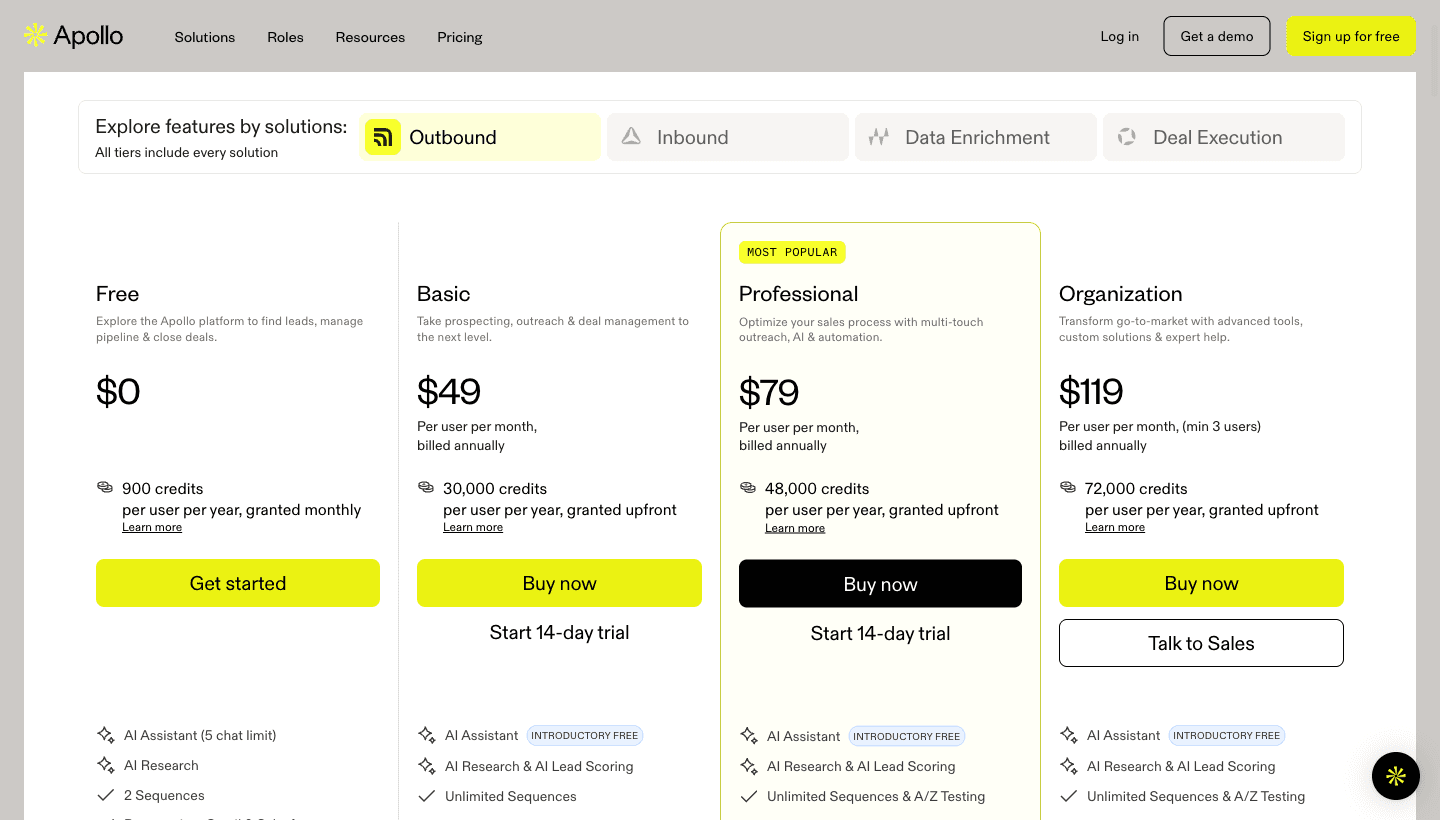
Apollo's pricing is public and self-serve, which is a real advantage in a category full of sales-led quotes. Verified directly on apollo.io/pricing:
All paid plans are annual. Credits gate email and phone reveals. For how Apollo's pricing stacks up against the field, see Apollo vs ZoomInfo and our best Apollo alternatives roundup.
Apollo's data is good for the price, but not flawless. According to third-party reviewers (e.g., Cleanlist's 2026 Apollo analysis), the 275M+ headline drops materially when you filter for verified emails, and a meaningful share of records carries at least one outdated field. We could not independently audit Apollo's database, so these figures should be treated as third-party-reported estimates rather than verified ground truth. Aggregated G2 reviews and practitioner field tests give this picture:
A practical test: pull 100 to 500 contacts in your actual target market, verify the emails, and run a small phone sample before committing budget. Accuracy varies enough by segment that your own sample beats any published average. To raise match rates beyond what one database delivers, many teams add waterfall enrichment that cross-checks several providers.
Across G2 (~4.7/5 across ~9,344 reviews at the time of writing), Trustpilot, and practitioner communities, the themes are consistent. Users praise Apollo's ease of use, filtering, and value for money, and many describe it as the best all-in-one for the price. Apollo has historically been one of the most-reviewed products in the Sales Intelligence category on G2, and a January 2026 PRNewswire announcement reported it was named the top AI-Native Sales Intelligence Platform in G2's 2026 Best Software Awards (treat the "#1" framing as an industry award win rather than an independent technical benchmark). The most common criticisms are data accuracy on phones, occasional stale records, and customer-service friction on billing. On balance, sentiment skews positive, with the strongest endorsements coming from SMB teams running email-led outbound.
If Apollo is not the right fit, the best alternative depends on your gap. For enterprise depth and intent, ZoomInfo; for European data, Cognism; for email-only simplicity, Hunter. For the most common reason teams leave, wanting higher match rates and clean email plus phone, a waterfall enrichment tool like Enrich combines multiple providers and writes clean records back to your CRM. See our full best Apollo alternatives roundup and the Enrich vs Apollo comparison.
Apollo.io is still worth it in 2026 for the audience it was built for: startups and SMBs that want an all-in-one prospecting and outreach platform at a transparent price. The free plan makes it low-risk to try, the G2 reception is overwhelmingly positive, and the value is genuine.
The honest caveats are phone accuracy, data freshness, and the coverage gaps any single database carries. If your priority is the highest possible match rate and clean CRM data, pair Apollo with waterfall enrichment or evaluate it directly. Enrich combines multiple providers to lift coverage and returns email and phone in one record, on transparent pricing without per-seat fees. Start with Enrich's pricing or see the Enrich vs Apollo comparison.
For startups and SMBs running email-led outbound, yes. Apollo offers an all-in-one workflow at transparent prices with a usable free plan (900 credits per seat per year), and the data is good enough for most SMB motions. It is less worth it if you need the best direct dials and deep intent, where dedicated providers like ZoomInfo and Cognism win.
Apollo's email data is broadly reliable for SMB outbound when you use its verification, but the 275M+ headline drops sharply when filtered for verified emails. Phone and direct-dial accuracy is weaker and varies by region. Independent tests have reported elevated bounce rates outside the verified subset. Always test a sample in your own market, and consider waterfall enrichment to lift match rates.
Apollo offers a free plan with 900 credits per seat per year, Basic at $49/seat/month with 30,000 credits/year, Professional at $79/seat/month with 48,000 credits/year, and Organization at $119/seat/month (minimum 3 seats) with 72,000 credits/year. All paid plans are billed annually.
Yes. Apollo's free plan includes 900 credits per seat per year (granted monthly), 2 sequences, the Chrome extension, and basic filters. No credit card required to start.
It depends on your need: ZoomInfo for enterprise depth, Cognism for Europe, Hunter for email-only. For higher match rates and clean email plus phone, a waterfall enrichment tool like Enrich is the strongest alternative. See our best Apollo alternatives roundup.
100 free API credits. No credit card required. Start enriching data in minutes.